Why Small Businesses Collapse in Africa
March 1, 2026 • ClickBase • Business Growth & Strategy • 156 views
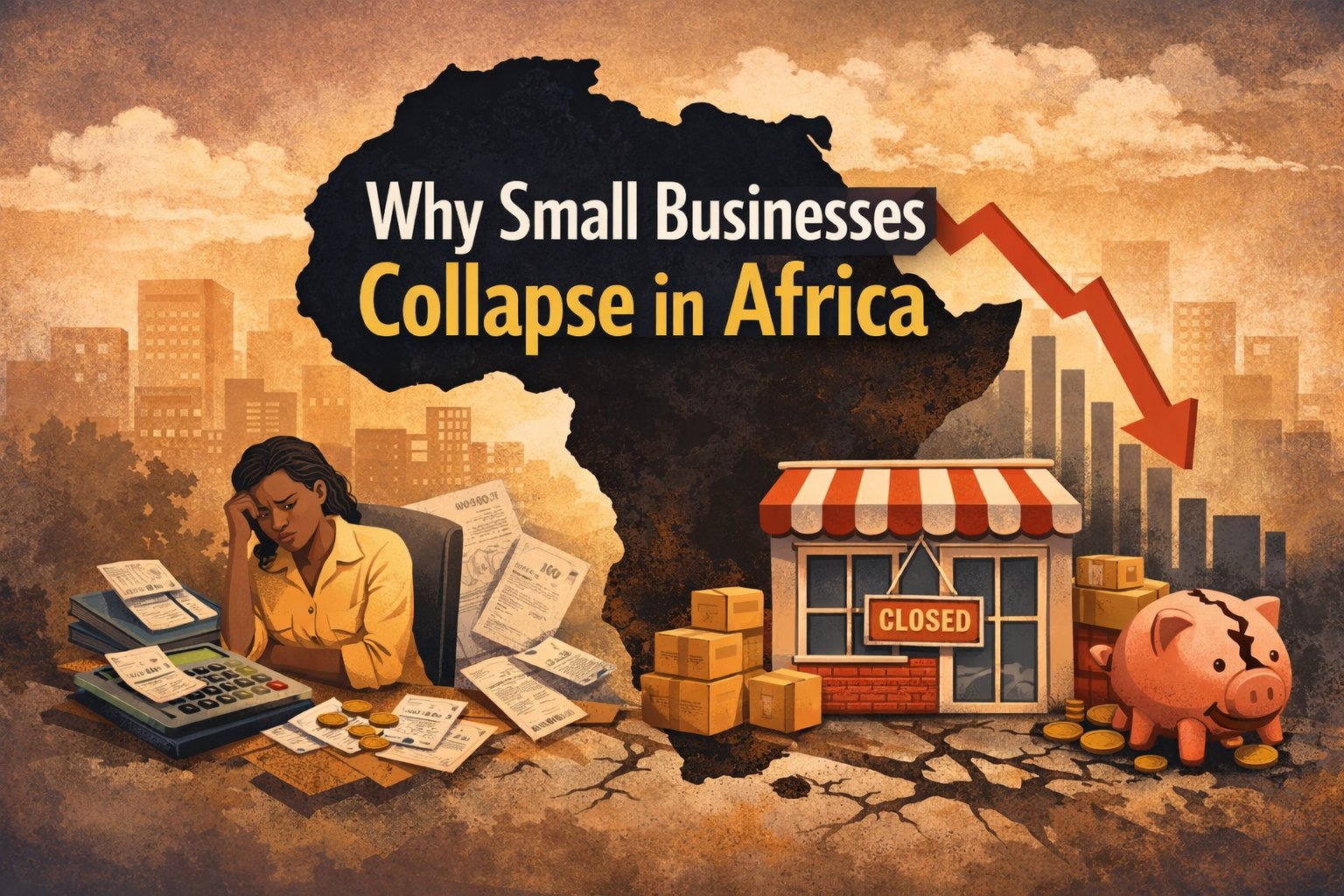
Across Africa, millions of small businesses are born every year. From traders in bustling markets in Lagos to startups operating in co-working spaces in Accra, entrepreneurship is alive and energetic. Young people are starting fashion brands, logistics companies, digital agencies, mini import businesses, and tech startups.
Yet behind this energy is a hard truth: a large percentage of small businesses in Africa shut down within their first five years.
Why does this keep happening?
The reasons are not mysterious. They are structural, financial, and operational. And most of them are preventable.
1. Poor Financial Management
This is the number one silent killer.
Many small business owners do not separate personal money from business money. Revenue goes into a personal bank account. Expenses are paid casually. There is no proper bookkeeping. No balance sheet. No cash flow tracking.
Without financial structure, owners do not know:
-
Whether they are actually profitable
-
How much stock is left
-
How much customers owe them
-
Whether they can survive a slow month
In cities like Nairobi and Kampala, you will find businesses that look busy every day but collapse because the owner cannot account for money leakage.
Profit is not the same as cash flow. Many businesses die not because they are unprofitable, but because they run out of cash.
2. Lack of Record Keeping
A surprising number of entrepreneurs still rely on notebooks, memory, or WhatsApp messages to track transactions.
This creates:
-
Disputes with customers
-
Missed payments
-
Underpricing
-
Inventory mismanagement
Without proper invoices and receipts, businesses lose credibility. Customers delay payment because there is no formal documentation.
In competitive markets like Johannesburg, professionalism is not optional. If your competitor sends structured invoices and you send text messages, clients will gradually shift away.
Documentation builds trust. Trust drives growth.
3. Over-Dependence on One Income Source
Many small businesses rely on:
-
One big customer
-
One product
-
One supplier
The moment that relationship breaks, the business struggles.
Supply chain disruption, currency fluctuations, or a delayed payment can destabilize operations completely.
Diversification is not luxury; it is survival.
4. Weak Business Structure
A common pattern across Africa is starting operations before building systems.
There is:
-
No defined pricing model
-
No standard operating procedure
-
No growth strategy
-
No clear target market
Some businesses chase every opportunity without specialization. They become everything to everyone and eventually lose direction.
Clarity beats chaos.
5. Limited Access to Funding
Access to affordable financing remains a challenge across many African economies.
Traditional banks often require:
-
High collateral
-
Strong credit history
-
Formal documentation
Most small businesses cannot meet these requirements.
Without capital, growth becomes slow. Expansion becomes risky. Inventory cycles become tight.
However, funding is not the root problem in many cases. Investors and lenders require transparency. Businesses that cannot produce financial statements rarely attract capital.
Structure attracts funding.
6. Inconsistent Marketing
Many entrepreneurs believe that once they open a shop or launch a website, customers will automatically come.
They underestimate:
-
Branding
-
Digital presence
-
Customer retention
-
Referrals
In major economic hubs like Cairo, competition is fierce. Visibility determines survival.
A business without marketing is invisible. An invisible business eventually disappears.
7. Economic Instability and Policy Shifts
African markets are dynamic.
Currency volatility, import restrictions, fuel price increases, and sudden regulatory changes can disrupt small businesses severely.
For example:
-
Exchange rate fluctuations affect importers
-
Fuel hikes increase logistics costs
-
Tax policy changes impact margins
Businesses without financial buffers cannot absorb shocks.
Resilience requires planning.
8. Poor Customer Experience
Customers leave quietly.
Many small businesses focus heavily on sales but ignore:
-
Service quality
-
Communication
-
Delivery timelines
-
After-sales support
In the age of social media, one negative review spreads quickly.
Customer loyalty is cheaper than constant customer acquisition.
9. Founder Burnout
Entrepreneurs often work alone. They manage sales, accounting, marketing, operations, and customer service simultaneously.
Without delegation or systems, burnout sets in.
When the founder becomes overwhelmed, decisions become emotional instead of strategic.
Sustainable growth requires structure, tools, and team support.
10. Lack of Data-Driven Decisions
Decisions are frequently based on assumptions instead of numbers.
Questions rarely answered with data:
-
Which product sells most?
-
Which month is slowest?
-
Which customers pay late?
-
Which channel brings highest profit?
Without data, growth becomes guesswork.
Data creates clarity. Clarity creates confidence.
The Way Forward
Small businesses in Africa are not collapsing because Africans lack talent or drive. The entrepreneurial spirit across the continent is strong.
The collapse happens because of weak systems, poor financial discipline, limited documentation, and reactive decision-making.
The future belongs to structured businesses.
Businesses that:
-
Track every transaction
-
Issue proper invoices
-
Separate business and personal finance
-
Monitor cash flow
-
Analyze performance monthly
Growth is not accidental. It is engineered.
Africa’s economic transformation will not be driven only by large corporations. It will be driven by millions of disciplined small businesses that choose structure over chaos.
The opportunity is massive. The solution is practical. The difference is execution.
And execution starts with structure.